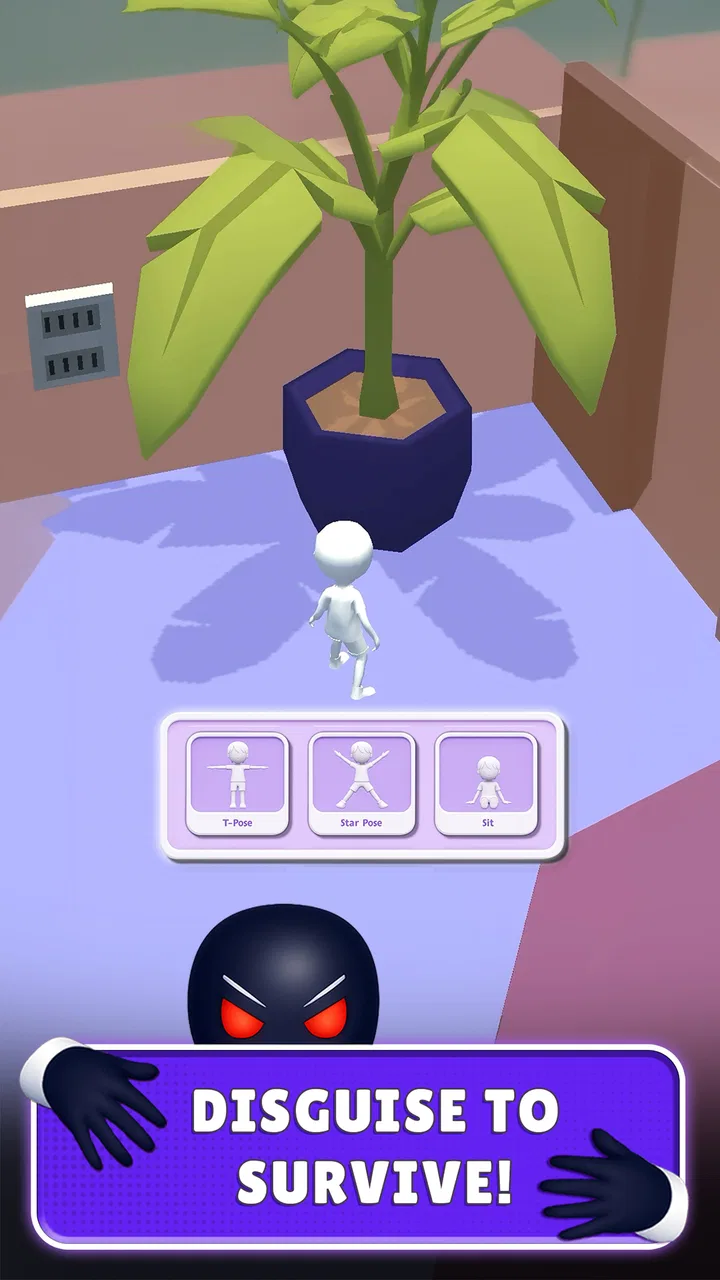
Hunt & Seek: Disguise & Escape
- 4.3
- Rating
- 50.00M
- Installs
- Free
- Price

 Analysis by App-foxy
I picked up Hunt & Seek expecting a quick casual distraction, and that is exactly where it works best. It is a light hide-and-chase game from Kwalee Ltd, built around a simple choice: stay out of sight or take the role of the hunter. The idea is easy to understand within moments, which makes it a natural fit for short sessions on a shared phone or tablet.
What surprised me was how much the game depends on the mood of the room. It can be a private time-killer while waiting for an appointment, but it also works as a small pass-around game when several people are nearby. One person can finish a turn, hand over the device, and let someone else try. That makes it more sociable than many casual games that are designed entirely around one player staring at a personal progress screen.
The free entry point helps, although the experience is not completely free of commercial friction. Optional purchases cost between $1.99 and $2.99 per item, so I would treat it as a game to try first rather than something to buy for every member of a household immediately. Its average rating is 4.3 from around 418 thousand ratings, and it has passed 50 million installs, which suggests that the basic format has found a broad audience without making it a deep or demanding game.
You May Also Like

 Blood Strike: 2.5 Anniversary
Blood Strike’s Loadouts Turn Every Drop Into a Tactical Gamble
A close look at Blood Strike’s custom loadouts: how fast access to signature weapons reshapes its battle royale rhythm, rewards preparation, and narrows the gap between fights.

 Pandora - Music & Podcasts
Pandora’s Music Is Easy to Start, but Harder to Recover
Pandora’s strength is its low-effort path from a seed to a station. Its weak spot is how much confidence it asks you to place in connection, setup, and quiet recovery.

 8 Ball Pool
 Is Built on Rivalries, Rematches, and Routine
A close look at the rivalries, rematches, shared routines, and unanswered safety questions that turn a quick pool match into a persistent mobile community.

 Samsung Music
’s Quiet Strength Is Playing What You Already Own
Its reach comes less from spectacle than from dependable access to a personal library. That simplicity is both the app’s strongest retention engine and its ceiling.

 AccuWeather: Weather Radar
AccuWeather Review: A Quick, Clear Forecast for Everyday Decisions
For everyday plans, the best forecast is the one you can understand quickly. AccuWeather makes rain timing, radar, and local conditions easy to act on, with a few trade-offs.

 Hill Climb Racing
Why Hill Climb Racing Still Turns Crashes Into One More Run
A tiny car, a bumpy hill and one more upgrade: Hill Climb Racing keeps resurfacing because its simple chaos makes every near-miss feel personal.
More From Our News Desk
View All News


How Hunt & Seek Fits Into Shared Play
When I think about Hunt & Seek as a shared game, the useful question is not just who gets the next turn, but how to keep each attempt feeling like that player’s own decision. I’d make a quick turn order before starting and let the person holding the device finish without live coaching. That simple boundary makes it easier for different ages and confidence levels to join in, while keeping the hide-or-hunt choice at the center of the fun.
A good choice for quick household turns
The strongest everyday use case is a shared device during a short break. Imagine a family waiting for food at a restaurant, or two friends sitting together while one phone is available. The game’s central hide-or-hunt idea is immediately readable, so nobody needs a long explanation before taking a turn. That matters when the goal is to fill a few minutes rather than begin a serious gaming session.
I also found that the simple premise makes it easy for different skill levels to coexist. A younger player can understand the basic objective, while an older player can think more carefully about timing and movement. Nobody has to learn a large collection of characters, menus, or rules before contributing. The result is not a competitive party game in the formal sense, but it can create that familiar “let me try once” feeling around a single screen.
There is a trade-off here. Because the game is made for fast understanding, it does not offer the kind of layered strategy I would expect from a larger action or stealth title. If your household wants a game with long-term planning, elaborate teamwork, or a substantial story, this will feel thin. Its appeal is the immediate decision-making, not a complex campaign.
Why the hunter and hider roles feel different
Switching between hiding and hunting changes the way I look at the same short session. As the hider, I pay attention to staying unnoticed and choosing the right moment to move. As the hunter, I become more active and direct, looking for a useful route through the space rather than simply reacting. That contrast gives the game more variety than its short description might suggest.
My practical tip is to avoid treating every turn as a race. When I rushed, I often made decisions that were easy to predict. A slower approach gave me more time to read the situation and decide whether the safest move was to remain patient or take a risk. This is one of the game’s less obvious strengths: it rewards restraint in a way that is easy to miss if I focus only on moving quickly.
For shared play, I would also encourage players to agree beforehand on whether they are giving advice. If everyone is watching one person’s turn, shouted instructions can remove the fun from the decision. Keeping observers quiet until the turn ends makes the handoff fairer and lets each player develop a personal approach.
Setting expectations before sharing the device
Hunt & Seek is rated Everyone 10+, so I would not automatically place it in front of very young children just because the presentation is casual. The age context is useful for setting expectations: the game may be approachable, but it is still built around pursuit, hiding, and catching. Parents or guardians should decide whether that style suits the child who will be using the device.
The rating also helps in a mixed-age household. An older child or adult can understand the premise quickly and help a younger player with the controls, but I would keep the assistance limited. The best part of the game is making the choice personally. Constant coaching can turn a simple challenge into a demonstration where one person plays and everyone else dictates the outcome.
I would not use the game as a substitute for a proper child-focused device environment. The title itself does not give me a reason to assume that it provides household profiles, child locks, or separate account boundaries. If several people use the same phone, those boundaries need to come from the device owner’s normal arrangements rather than from expectations about the game.
Account boundaries matter more than the quick sessions suggest
Because the game is easy to pass around, it is tempting to let anyone tap through without thinking about ownership of the device or store account. I recommend deciding who is allowed to install it and who may approve optional purchases before handing it over. The in-app price range is modest compared with many larger games, but an accidental purchase is still an avoidable household problem.
That is especially important when a child borrows an adult’s phone. A free download does not mean every screen that follows should be treated casually. I would keep the device owner responsible for installation and payment decisions, then let other players use the game only after those expectations are clear. This is a simple routine, but it prevents the game’s quick, inviting format from blurring who is actually in control of the account.
I also prefer to keep one person responsible for updates. The current version is 2.1.8, and the minimum operating system is 7.1. Those details make it accessible to a range of older devices, but a shared device still benefits from one person checking that the game remains available and behaves properly after an update. That is more practical than asking every household member to manage the installation separately.
Coordination makes the game more enjoyable
When several people are sharing one screen, a small amount of coordination improves the experience considerably. I would use a simple turn order and let each person complete a full attempt before passing the device. This prevents the most confident player from taking over and gives quieter players a clear chance to participate.
A useful variation is to give observers a role without letting them control the turn. They can predict whether the player will hide or hunt successfully, then compare the prediction with what actually happened. This adds conversation without inventing a team system that the game itself may not provide. It also works well when one person is not comfortable playing yet but still wants to be involved.
Another practical tip is to avoid coaching from two people at once. Conflicting advice is frustrating, particularly for a child who is still learning the game’s rhythm. I would let the player ask for help, then offer one suggestion rather than a stream of commands. That keeps the challenge intact and makes the eventual success feel earned.
The game is also suitable for a short “best of” session, but I would not stretch it indefinitely. Casual games can lose their charm when every turn becomes an argument about who is next. A clear stopping point, such as giving everyone one or two attempts, keeps the experience friendly and makes it easier to return to later.
Where it stands beside familiar casual alternatives
Compared with an endless runner, Hunt & Seek feels less automatic because the hide-or-hunt decision gives each attempt a clearer tactical purpose. An endless runner is usually better when I want a continuous reflex challenge with no social explanation. This game is better when I want a premise that another person can understand by watching for a few seconds.
Compared with a match-three puzzle game, it offers less of the calm, methodical planning that suits quiet solo play. Puzzle games are often easier to pause mentally and revisit at the same pace. Hunt & Seek has more immediate tension because the player is thinking about being found or finding someone else. I would choose the puzzle alternative for relaxed concentration and this one for a livelier shared moment.
It also differs from a full stealth game. There is no reason to approach it expecting detailed level design, a large narrative, or the control depth of a console-style experience. Its advantage is that it strips the idea down to a few readable decisions. That makes it more approachable, but the same simplicity limits how long it may hold the attention of experienced players.
What I would watch for during everyday use
The main limitation is repetition. The first sessions benefit from the novelty of switching roles, but players who need constant new systems may run out of interest sooner than they would with a larger game. I would install it for short breaks, casual handoffs, and occasional shared play, not as the only game on a household tablet.
The free model is another consideration. I appreciate being able to try the core experience without paying first, but optional purchases mean I would not leave a payment-enabled device unattended with a child. This is not a reason to reject the game; it is simply part of using any free casual title responsibly in a shared environment.
Performance expectations should also be realistic. The minimum operating system of 7.1 means the game can suit older compatible devices, but operating-system support alone does not tell me how comfortable every older phone will feel. I would test it on the actual shared device before planning a long group session, especially if several people are waiting for a turn.
Finally, I would skip it if the intended player dislikes chase themes or prefers games with a clearly cooperative objective. The central tension comes from one side hiding and another side searching. Someone looking for peaceful creation, wordplay, or a structured multiplayer team experience will probably be happier elsewhere.
Who will get the most from it
I think the best audience is someone who wants a casual game that can be understood quickly and played in small pieces. It suits a person who enjoys switching between cautious hiding and active hunting, and it works particularly well when a friend or family member is close enough to watch and take a turn.
It is also a sensible option for households that share one device but do not want to create a complicated gaming routine. The simple controls and clear premise reduce the learning barrier. Still, the owner should remain in charge of installation, purchases, and deciding whether the age context is appropriate for each player.
I would be more cautious about recommending it to a dedicated gamer seeking lasting progression or a deep competitive system. The game’s strength is immediate accessibility, not extensive mastery. If I wanted a long evening of strategic play, I would choose a more substantial title in another part of the casual or action market.
My household verdict
After using it as both a solo distraction and a pass-around game, I see Hunt & Seek as a practical choice for short, informal play. It turns a familiar chase idea into something that can begin quickly, and the role change gives each session a little more character than a one-directional reflex game. The experience is especially effective when players agree on turns, keep advice under control, and treat the device owner’s account boundaries seriously.
Kwalee Ltd has kept the concept approachable, and the 4.3 average from a large audience reflects why it is easy to pick up. I would not confuse popularity with unlimited depth, though. The game can become repetitive, optional purchases require sensible supervision, and its Everyone 10+ rating deserves attention when children are sharing an adult’s device.
My recommendation is simple: try it free if you want a quick hide-and-hunt game that can move naturally between solo use and household play. Keep the sessions short, decide in advance who controls the account, and choose something deeper if your group wants extended strategy or a richer cooperative structure. Used in the situation it suits, it is an enjoyable little game rather than a commitment, and that is exactly why I would keep it available for those spare minutes when a shared screen needs something everyone can understand.
FAQs for Hunt & Seek: Disguise & Escape
01What is the main objective of Hunt & Seek?
Hunt & Seek is a thrilling hide-and-seek game that involves strategy and quick thinking. Players can choose to be the hunter or the one hiding. The goal is to find all hidden players within a time limit if you're the hunter, or avoid being found to win the round if you're hiding.
02Is Hunt & Seek suitable for children?
Yes, Hunt & Seek is designed to be family-friendly and is suitable for children. The game features colorful graphics, intuitive controls, and engaging gameplay, making it accessible and entertaining for younger audiences. However, parents may want to supervise gameplay to ensure appropriate use.
03Does Hunt & Seek require an internet connection to play?
Hunt & Seek can be played both online and offline. While playing online allows you to compete with friends or players worldwide, the offline mode offers solo gameplay against AI opponents. This flexibility ensures you can enjoy the game in various settings and situations.
04Are there in-app purchases available in Hunt & Seek?
Yes, Hunt & Seek offers in-app purchases. Players can buy cosmetic items, additional characters, or special power-ups to enhance their gameplay experience. While these purchases are optional, they can provide a more personalized and enjoyable gaming experience.
05What devices are compatible with Hunt & Seek?
Hunt & Seek is available for both Android and iOS devices. It is compatible with most smartphones and tablets running recent operating systems. Make sure your device meets the minimum requirements listed in the app store to ensure smooth gameplay and performance.
Pros
- Engaging gameplay with varied levels.
- Intuitive controls and easy to learn.
- Vibrant graphics enhance immersion.
- Regular updates with new content.
- Multiplayer mode for social fun.
Cons
- Ads can be frequent and distracting.
- Requires stable internet connection.
- In-app purchases can be pricey.
- Battery drain on extended play.
- Limited offline functionality.

Hunt & Seek: Disguise & Escape
Gallery